
Task Steps
Task steps are the executable units inside an automation task. This page explains the currently available step types, what each step requires, and how to configure steps so executions are predictable in production.
Step Availability by Task Type
Available for General and Certificate Tasks
• PowerShell Script
• Bash Script
• Runbook
• Run Command
• Manage Windows Service
• Execute DevOps Pipeline
• Execute GitHub Workflow
• Azure Resource Action
• TOPdesk Incident
• TOPdesk Change
• Active Directory Action
• SCOM Maintenance Mode
• Windows DNS
• Simply.com DNS
• Azure DNS
• Amazon Route 53 DNS
• Cisco Umbrella
• Copy Files
• Zip / Unzip
Certificate-Only Step Types
• Azure Application Gateway
• Azure Key Vault (certificate target)
• Certificate Install
• Citrix ADC / NetScaler Certificate
• Application Proxy Certificate
• Application Certificate
• Azure Certificate Deployment

 PowerShell Script Step
Executes a stored script on a selected AZExecute client machine.
Required: Client Machine + Script
Optional: PowerShell version and script parameter values
• PowerShell version selector is shown when the selected machine reports PowerShell Core support.
• Parameters support static values, linked task parameters, and variables created by earlier steps.
• Scripts can create output variables for later steps by writing ::azx-set-var:Name=Value to output.
• Output variable names can contain spaces and punctuation, but not = or line breaks. Later steps reference them with {{ Name }}.
• If the script imports PowerShell modules, assign those modules to the selected agent or its agent group before running the task.
• Good fit for custom logic and legacy integration on managed machines.

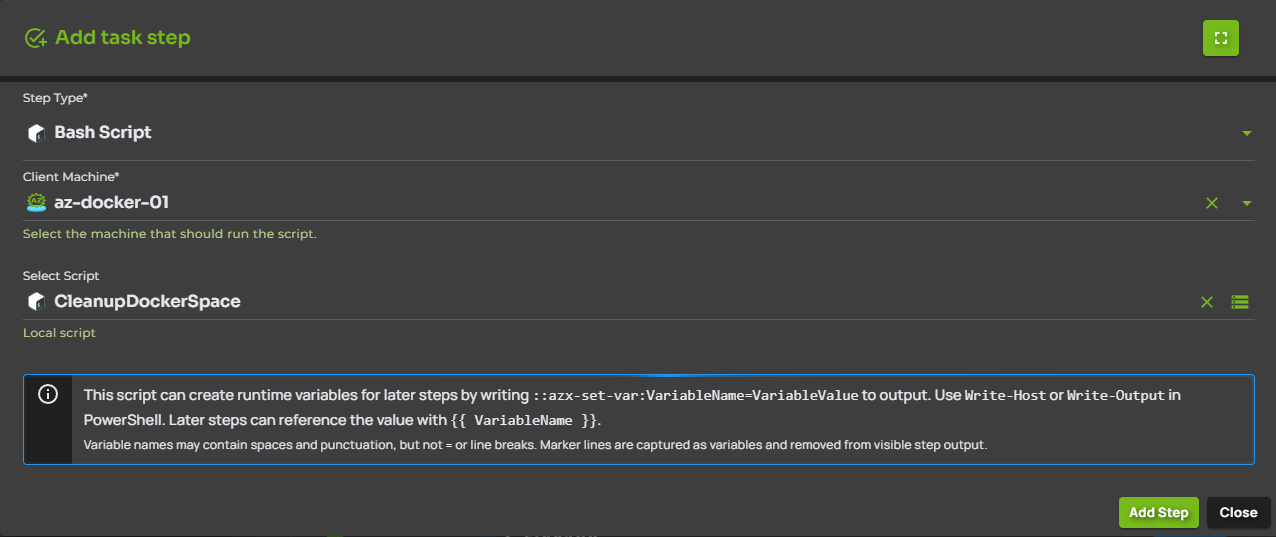
 Bash Script Step
Executes a stored Bash script on a selected Linux-capable AZExecute client machine.
Required: Client Machine + Script
Optional: Script parameter values
• Use for Linux-based automation and shell workflows managed by AZExecute agents.
• Parameters support the same variable reference pattern as other task steps.
• Keep script output readable; only write output variable markers for values that later steps need.
 Runbook Step
Executes a runbook from an Azure Automation Account.
Required: Automation Account + Runbook + Run On target
Optional: Runbook parameters
• Run On can be Azure (cloud) or a Hybrid Worker Group.
• Parameter inputs are generated from the selected runbook parameter definitions.
• Use for Azure-native operations or workflows already standardized in runbooks.

 Run Command Step
Runs a stored script on an Azure VM through Azure Run Command.
Required: Subscription + Virtual Machine + Script
Optional: Script parameters
• VM list is loaded from the selected subscription.
• Includes script preview and parameter input when script parameters exist.
• Best for short/medium remote actions on Azure VMs without deploying AZExecute client agent there.

 Azure Key Vault Step (Certificate Tasks)
Targets a Key Vault certificate entry for certificate deployment/update.
Required: Key Vault + Certificate Name
• Key Vault picker is grouped by tenant and supports cross-tenant visibility based on settings/access.
• You can select an existing certificate name or type a new one.
• Use this to keep certificate targets centralized for Azure workloads.

 Certificate Install Step (Certificate Tasks)
Installs certificates on a selected AZExecute client machine.
Required: Client Machine
Optional: PFX export, cleanup, IIS binding update, binding entries
• Supports private key exportability and optional PFX export path/password.
• Supports cleanup of older certificates generated by AZExecute naming pattern.
• IIS binding updates can be configured with one or many binding entries.

 Windows Service Action Step
Performs service operations on a selected AZExecute client machine.
Required: Target Machine + Service Name + Action
Optional: Startup Type + Startup Parameters (for Configure action)
• Service Name expects the internal service name, not display text.
• Actions include Start, Stop, Restart, and Configure.
• Common in post-deployment sequences (for example after cert or config updates).

 Azure Application Gateway Step (Certificate Tasks)
Targets Azure Application Gateway certificate integration in certificate workflows.
Required: Application Gateway target details based on your environment configuration
 Execute DevOps Pipeline Step
Triggers Azure DevOps pipelines from within your task workflow.
Required: Organization + Project + Pipeline
Optional: Branch + pipeline parameters
• Organizations are listed by tenant and then projects/pipelines are loaded progressively.
• Branch suggestions are loaded from pipeline details.
• Pipeline parameters support task-level variable usage through linked custom parameters.

Execute GitHub Workflow Step
Dispatches a GitHub Actions workflow from an automation task using a tenant GitHub App integration.
Required: GitHub Integration + Repository + Workflow + Ref
Optional: Workflow input values
• Select a GitHub App installation integration configured in TenantAdmin - Integrations - GitHub.
• Choose one of the repositories available to the installed GitHub App.
• Select a workflow that supports workflow_dispatch.
• Ref can be a branch, tag, SHA, or value from an earlier task variable.
• Workflow inputs are discovered from the workflow file and can be filled with static values, custom parameters, or output variables from previous steps.
 Azure Resource Action Step
Runs a targeted action against an Azure resource, such as operational actions for App Service, virtual machines, or other supported Azure resources.
Required: Azure resource selection + supported action
• Use this when the workflow needs to start, stop, restart, or otherwise operate on an Azure resource.
• Resource and action availability depends on your tenant access and the selected resource type.
• Resource fields can use variables from earlier steps, which is useful in reusable deployment workflows.
 TOPdesk Incident and Change Steps
Creates, updates, assigns, closes, cancels, archives, or unarchives TOPdesk records using a configured TOPdesk integration. Use the Incident step for operational incidents and the Change step when the workflow needs to open or update formal change records.
Required: TOPdesk integration + operation-specific incident or change fields
Optional: Saved incident reference name, caller lookup, category, operator group, processing status, and action text
• Create operations can publish output variables such as {{ topdesk_incident_number }} and {{ topdesk_incident_id }}.
• If you set a saved reference name, later TOPdesk update, close, cancel, archive, or unarchive steps can target the same record without manually entering the number.
• Step-scoped variables are also available for tasks that create more than one TOPdesk record in the same run.
 Active Directory Action Step
Performs Active Directory actions through an AZExecute agent with access to the target domain.
Required: Active Directory integration + operation-specific identity fields
Operations: Create User, Create Group, Add Group Members, Update User Attributes
• Create User and Create Group can publish values such as {{ samAccountName }}, {{ distinguishedName }}, and {{ objectGuid }}.
• Namespaced variables such as {{ active_directory_user_sam_account_name }} or {{ active_directory_group_distinguished_name }} help keep multi-step tasks readable.
• Use step-scoped variables when one task creates multiple users or groups and later steps must reference a specific step's result.
SCOM Maintenance Mode Step
Starts or stops SCOM maintenance mode through an enabled SCOM integration. The integration targets a connected Windows AZExecute agent; AZExecute does not store separate SCOM credentials for this step.
Required: SCOM integration + target managed computer + operation
Optional: duration, comment, reason, and management server override
• Configure SCOM integrations from Tenant Admin > Integrations > SCOM.
• The selected integration must point to a currently connected Windows agent with the OperationsManager PowerShell module available.
• The integration can specify a SCOM management server, or leave it blank to use the agent machine's existing SCOM connection context.
• AZExecute uses the selected integration to look up managed computers and apply the requested maintenance-mode action.
• Use before planned changes to suppress avoidable monitoring alerts.
• Place the start step before deployment work and the stop step in a later cleanup or verification stage.
• Keep SCOM steps sequential when deployment steps depend on maintenance mode being active first.


 DNS and Network Security Steps
DNS and network-security steps let a task create, update, or remove name-resolution records without asking operators to leave the workflow. They are useful for certificate validation, onboarding, decommissioning, and environment provisioning.
• Windows DNS: manages Windows-hosted or AD-integrated DNS zones and records through a connected Windows agent.
• Simply.com DNS: manages records through a configured Simply.com integration.
• Azure DNS: manages Azure DNS records through configured Azure DNS credentials.
• Amazon Route 53 DNS: manages Route 53 records through a configured AWS account integration.
• Cisco Umbrella: manages internal domains and destination-list entries through an AZExecute agent.
 Copy Files Step
Copies files or folders between AZExecute agents and Azure Blob Storage. Use it when a workflow needs to stage installers, collect logs, move generated output, or hand files from one environment boundary to another.
Required: transfer type + agent/storage selections + source and destination paths
Transfer types: Agent to Agent, Agent to Azure Blob, Azure Blob to Agent
• Agent-to-agent copies use paths reachable by the selected agents.
• Blob transfers use a selected storage account, container, and blob name or prefix.
• Output includes transfer type, source, destination, storage metadata, file count, and a structured copy_file_details JSON variable for later steps.
Zip / Unzip Step
Creates or extracts zip archives on a selected AZExecute agent. The step uses built-in .NET archive handling, so the same task design can work across Windows and Linux agents without relying on external zip tools.
Required: operation type + agent + source path + destination path
Operations: Zip or Unzip
• Zip creates an archive from a file or folder on the selected agent.
• Unzip extracts a zip archive to a folder on the selected agent.
• Optional overwrite behavior controls whether existing destination files can be replaced.
• Output includes operation type, source, destination, archive path or extraction folder, entry count, and a structured archive_details JSON variable.



 Certificate Integration Steps
Certificate tasks can deploy renewed certificates to several target systems. These steps usually consume certificate system variables and should run after the certificate has been issued.
• Citrix ADC / NetScaler Certificate: uploads and binds a certificate on Citrix ADC / NetScaler.
• Application Proxy Certificate: updates the SSL certificate for a Microsoft Entra Application Proxy enterprise application.
• Application Certificate: uploads a renewed certificate to an AZExecute-managed Microsoft Entra application registration.
• Azure Certificate Deployment: deploys a certificate to Azure-native services such as App Service, API Management, Container Apps, Front Door, CDN, or Kubernetes.
Common Step Behavior
Entra task steps use your configured Entra ID integration. The AZExecute Broker is read-only. To create or change directory objects, use your own connected agent with the required write permissions, or a suitably configured Customer Broker. See Entra ID Integration.
• Execution Order: Change with arrow controls, then persist with Save Step Order.
• Step Groups: Groups act as execution stages and keep related steps visually organized.
• Run with previous group: Starts a group in the same execution stage as the group above it.
• Execute in Parallel: Applies to an individual step and should only be used when that step has no dependency on sibling work.
• Stop on Failure: When enabled, failure in this step stops task progression.
• Unsaved Changes: Step edits are not active until saved with Save Step.
• Enabled/Disabled: Disabled steps are skipped without deleting configuration.
• Variables: Supported fields can use {{ VariableName }}. Later steps can consume variables created by earlier completed steps.